
Butterfly Valve Selection: How to Size Correctly for Peak Performance
Control Characteristics: Master the Effective Operating Window
The inherent near-equal-percentage flow profile makes butterfly valves a strong choice for throttling applications — but their performance has clear operational boundaries.
At disc openings below 15° to 20°, intense fluid throttling raises the risk of cavitation, erosion, vibration and disruptive noise. Near full open, in the 80° to 90° range, flow rates barely shift, so the valve loses practical regulation value. For reliable modulating duty, the recommended operating window sits between 20° and 70° of disc rotation.
For applications requiring low-opening control, serrated trim designs can improve low-flow stability. For reduced torque demands, dished, S-shaped or fishtail disc profiles are available to lower hydrodynamic torque and smooth flow behavior.
Flow Resistance & Flow Coefficient: Benchmark Against System Requirements
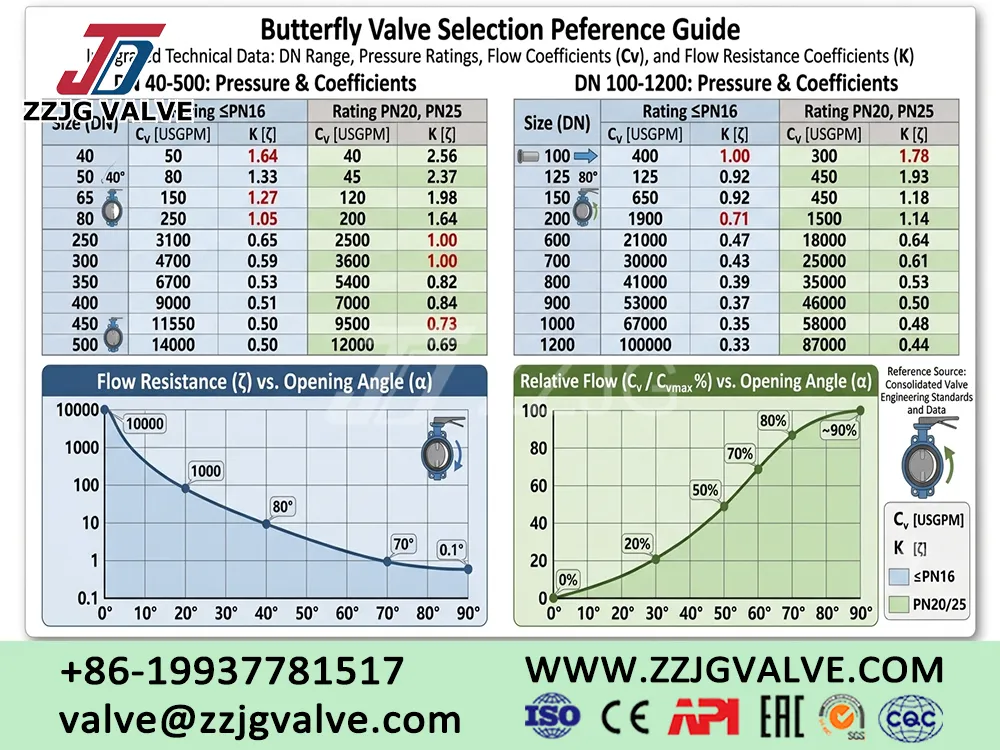
Pressure loss across a valve follows the formula Δp = ζρv²/2, where ζ represents the flow resistance coefficient, a value determined by the valve’s internal geometry. The flow coefficient (Cv/Kv) — the industry standard metric for flow capacity — is shaped by trim design, pressure differential across the valve and fluid density.
Engineers can reference industry standards such as JB/T 53171 to cross-reference rated Cv/Kv values by nominal diameter and pressure class, ensuring the valve aligns with pipeline pressure drop targets and system performance specifications.
Sizing Strategy: Tailor Bore Size to Your Application
Sizing logic differs significantly between on-off and control service.
For on-off isolation valves, the rule is straightforward: select a valve with a rated flow coefficient higher than the system’s maximum required flow, and match the nominal diameter to the pipeline.
For modulating control valves, additional guardrails apply. To maintain stable, accurate regulation, the valve should operate no lower than 20° at minimum flow, and no higher than 70° at peak flow, with line velocity typically held around 5 m/s. Reduced-bore sizing can boost throttling precision, but industry best practice recommends the valve bore never be smaller than half the pipeline’s nominal diameter.
Final Takeaway
Smart butterfly valve selection balances flow efficiency, control accuracy and long-term durability by aligning valve specifications with real-world operating conditions. Following these sizing and performance principles helps teams reduce downtime, cut maintenance costs and optimize overall fluid system performance.
The inherent near-equal-percentage flow profile makes butterfly valves a strong choice for throttling applications — but their performance has clear operational boundaries.
At disc openings below 15° to 20°, intense fluid throttling raises the risk of cavitation, erosion, vibration and disruptive noise. Near full open, in the 80° to 90° range, flow rates barely shift, so the valve loses practical regulation value. For reliable modulating duty, the recommended operating window sits between 20° and 70° of disc rotation.
For applications requiring low-opening control, serrated trim designs can improve low-flow stability. For reduced torque demands, dished, S-shaped or fishtail disc profiles are available to lower hydrodynamic torque and smooth flow behavior.
Flow Resistance & Flow Coefficient: Benchmark Against System Requirements
Pressure loss across a valve follows the formula Δp = ζρv²/2, where ζ represents the flow resistance coefficient, a value determined by the valve’s internal geometry. The flow coefficient (Cv/Kv) — the industry standard metric for flow capacity — is shaped by trim design, pressure differential across the valve and fluid density.
Engineers can reference industry standards such as JB/T 53171 to cross-reference rated Cv/Kv values by nominal diameter and pressure class, ensuring the valve aligns with pipeline pressure drop targets and system performance specifications.
Sizing Strategy: Tailor Bore Size to Your Application
Sizing logic differs significantly between on-off and control service.
For on-off isolation valves, the rule is straightforward: select a valve with a rated flow coefficient higher than the system’s maximum required flow, and match the nominal diameter to the pipeline.
For modulating control valves, additional guardrails apply. To maintain stable, accurate regulation, the valve should operate no lower than 20° at minimum flow, and no higher than 70° at peak flow, with line velocity typically held around 5 m/s. Reduced-bore sizing can boost throttling precision, but industry best practice recommends the valve bore never be smaller than half the pipeline’s nominal diameter.
Final Takeaway
Smart butterfly valve selection balances flow efficiency, control accuracy and long-term durability by aligning valve specifications with real-world operating conditions. Following these sizing and performance principles helps teams reduce downtime, cut maintenance costs and optimize overall fluid system performance.
Get in Touch With Us
Email: [email protected]
Mobiler/Whatsapp:+86-18135671959