
Why a Three-Piece Valve is the Fix Your AI Liquid Cooling Setup Actually Needs
Let’s be real: scaling up AI computing is mostly a giant fight against heat. Liquid cooling loops are the default fix now, but everyone forgets that the whole system lives or dies by its smallest hardware—specifically, the shut-off valves. If a valve creates too much drag, your PUE shoots through the roof because the circulation pumps are sweating. Even worse, if it seeps a single drop of glycol or deionized water onto a GPU motherboard? You just fried a fortune.
Traditional one-piece valves in these loops are honestly a nightmare. First, they bottleneck the flow. Second, they leak. Third, if a seal wears out, you have to drain the entire pipeline section just to swap it, driving up cluster downtime. And don't get me started on the internal "dead zones" that trap grime, creating a nasty sludge that clogs up server cold plates.
That is exactly why this new three-piece sanitary butterfly valve is a big deal.
Instead of a single, monolithic block, the design splits the valve into three distinct pieces: an upstream connector, a central body, and a downstream connector. When it's time for maintenance, technicians just back out the external bolts and pull the center. You don't have to tear down the piping, and you don't have to drain the coolant. Compared to standard integrated or flanged valves, this quick-swap approach cuts maintenance downtime by over 70%. For AI clusters that absolutely cannot go offline, it's a lifesaver.
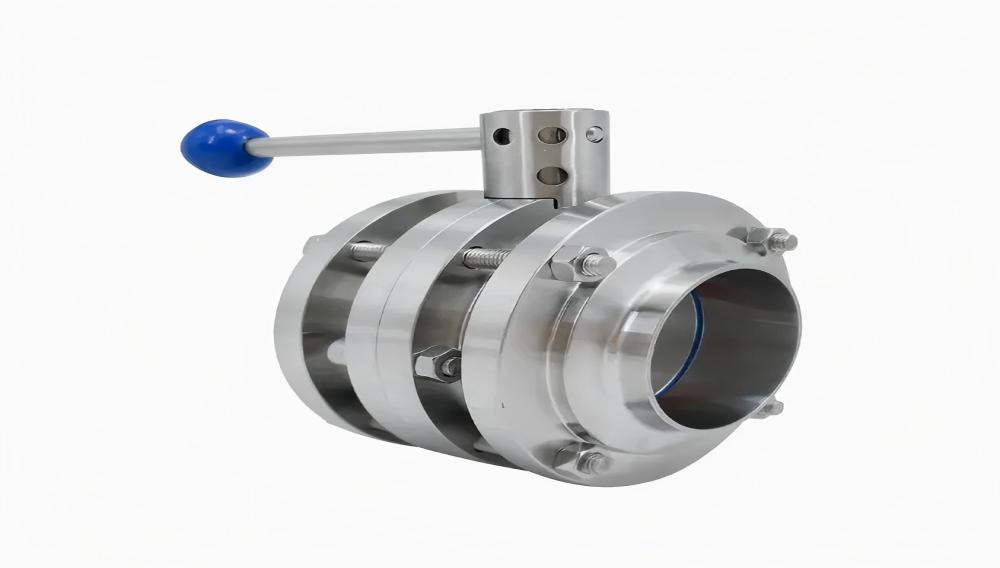
To kill the leakage problem for good, the valve uses a fully encapsulated, sanitary-grade gasket for a wafer-style soft seal. It hits the ANSI/FCI 70-2 Class VI zero-leakage standard dead on—meaning no fluid creeps toward your electronics. There is also a multi-layer packing setup around the stem to stop fluid from weeping up the shaft. Inside, the cavity gets a mirror polish down to Ra ≤ 0.8 μm. No grooves, no stagnant pockets. Debris has nowhere to hide, keeping the fluid pristine so server micro-channels stay clear.
Flow-wise, when this thing is wide open, it's basically a straight pipe. There are no steps or lips to cause turbulence, and the inner diameter matches the pipe perfectly. Sizes run from DN38 (perfect for tight rack manifolds) up to DN200 for heavy-duty CDU mainlines.
The build quality is solid, too. Forged from 304 or 316L stainless steel, it isolates copper and iron to completely dodge galvanic corrosion. It handles pure water, deionized water, and standard glycol mixes without breaking a sweat. For regular setups, EPDM seals come standard, but you can swap in FFKM seals if you are running specialized immersion cooling with fluorinated fluids. Because the materials introduce zero chemical leachables or metal ions, you won't get scaling inside those delicate cold plates.
Pressure ratings are set at 1.0 MPa and 1.6 MPa (fully PN16 compliant), and it handles temperatures from -20°C up to 120°C. It is built specifically to survive the brutal thermal cycling of fluctuating AI workloads without warping or aging the seals prematurely.
Where do you put it? Anywhere, honestly. It works for CDU primary water lines, as master isolation points on rack manifolds (so you can service specific server groups offline), or as zone shut-offs across the facility network. It even works as a safety shut-off for main pumps and immersion tanks.
Compliance-wise, it's already fully baked in. The sealing meets T/CAICI 131-2025 data center specs, and during GB/T 13927 testing, the body held up against 1.5 times its rated pressure with zero leaks. It satisfies GB/T 12224 cleanliness rules, and the low-drag interior lines up perfectly with GB 40879 energy metrics. If you're working on a new build or a facility retrofit, you can spec this valve in immediately without jumping through extra compliance hoops.
Traditional one-piece valves in these loops are honestly a nightmare. First, they bottleneck the flow. Second, they leak. Third, if a seal wears out, you have to drain the entire pipeline section just to swap it, driving up cluster downtime. And don't get me started on the internal "dead zones" that trap grime, creating a nasty sludge that clogs up server cold plates.
That is exactly why this new three-piece sanitary butterfly valve is a big deal.
Instead of a single, monolithic block, the design splits the valve into three distinct pieces: an upstream connector, a central body, and a downstream connector. When it's time for maintenance, technicians just back out the external bolts and pull the center. You don't have to tear down the piping, and you don't have to drain the coolant. Compared to standard integrated or flanged valves, this quick-swap approach cuts maintenance downtime by over 70%. For AI clusters that absolutely cannot go offline, it's a lifesaver.
To kill the leakage problem for good, the valve uses a fully encapsulated, sanitary-grade gasket for a wafer-style soft seal. It hits the ANSI/FCI 70-2 Class VI zero-leakage standard dead on—meaning no fluid creeps toward your electronics. There is also a multi-layer packing setup around the stem to stop fluid from weeping up the shaft. Inside, the cavity gets a mirror polish down to Ra ≤ 0.8 μm. No grooves, no stagnant pockets. Debris has nowhere to hide, keeping the fluid pristine so server micro-channels stay clear.
Flow-wise, when this thing is wide open, it's basically a straight pipe. There are no steps or lips to cause turbulence, and the inner diameter matches the pipe perfectly. Sizes run from DN38 (perfect for tight rack manifolds) up to DN200 for heavy-duty CDU mainlines.
The build quality is solid, too. Forged from 304 or 316L stainless steel, it isolates copper and iron to completely dodge galvanic corrosion. It handles pure water, deionized water, and standard glycol mixes without breaking a sweat. For regular setups, EPDM seals come standard, but you can swap in FFKM seals if you are running specialized immersion cooling with fluorinated fluids. Because the materials introduce zero chemical leachables or metal ions, you won't get scaling inside those delicate cold plates.
Pressure ratings are set at 1.0 MPa and 1.6 MPa (fully PN16 compliant), and it handles temperatures from -20°C up to 120°C. It is built specifically to survive the brutal thermal cycling of fluctuating AI workloads without warping or aging the seals prematurely.
Where do you put it? Anywhere, honestly. It works for CDU primary water lines, as master isolation points on rack manifolds (so you can service specific server groups offline), or as zone shut-offs across the facility network. It even works as a safety shut-off for main pumps and immersion tanks.
Compliance-wise, it's already fully baked in. The sealing meets T/CAICI 131-2025 data center specs, and during GB/T 13927 testing, the body held up against 1.5 times its rated pressure with zero leaks. It satisfies GB/T 12224 cleanliness rules, and the low-drag interior lines up perfectly with GB 40879 energy metrics. If you're working on a new build or a facility retrofit, you can spec this valve in immediately without jumping through extra compliance hoops.
Get in Touch With Us
Email: [email protected]
Mobiler/Whatsapp:+86-18135671959